Forward Parking Into a Bay
Bay parking on the test is usually carried out in the (relatively controlled) grounds of the test centre. The forward bay park, however, is designed to reflect real-life situations such as hotel and supermarket car parks.
Anyone with experience of reversing out of a bay at a supermarket will know that your observation skills are highly tested here. Many pedestrians have little regard for a reversing vehicle and will assume that you see them as they walk directly behind your car. Children can be running around, trolleys may roll out, impatient drivers can shoot past as you’re reversing and other vehicles may be reversing at the same time – the list goes on.
If you are asked to carry out the forward bay parking manoeuvre, you’ll hopefully be taken to a quieter section of the car park. But you should practise and prepare so your observation and control skills work under all conditions. Reference points make manoeuvres easier as they give a guide to where your car is. These are provided on the forward bay reference points guide.
We offer patient, step-by-step lessons across Hackney and East London.
Manual lesson prices →
Automatic lesson prices →
What the Examiner Is Looking For
Three key skills are required to successfully carry out the forward bay parking manoeuvre:
- Control: Keep the vehicle at a slow, controlled speed.
- Accuracy: Steer the vehicle cleanly into the bay, staying within the lines, and reverse out safely.
- Observation: Be aware of everything happening around you and react correctly.
We specialise in nervous and beginner drivers with clear, simple instructions.
Contact us to check availability →
How the Forward Bay Parking Manoeuvre Works
The forward bay parking manoeuvre will be carried out in a car park where you have a choice of bays. The examiner will not use a car park with only one usable bay.
You will usually be able to choose a bay with cars on both sides, one side or no cars at all. The exact instruction depends on the layout of the car park. For example, if bays are only on the right side, this will be reflected in the instructions.
In simple terms, the examiner will ask you to drive forward into a bay (to the left or right if both are available) and then reverse out again. The choice of bay is up to you.
Rules for This Manoeuvre
- You cannot drive through the first parking bay and park in the bay in front of it.
- When reversing, you must not reverse into any bays behind you.
- You are allowed to make corrections. If you feel you are too close to a line or on it, you may reverse a little to adjust your position.
How to Forward Park Into a Bay – Tutorial
- You may choose a bay with cars parked on both sides, one side, or clear both sides. Tip: if possible, pick a bay with clear space on both sides as this makes observations while reversing much easier.
- Keep the car very slow throughout – think slow walking pace. This helps you stay accurate and gives more time for observation.
- Continuously check your mirrors and all around the vehicle. If pedestrians, cyclists or other vehicles approach, stop and wait. If another driver clearly waits for you, continue but only after checking all around to confirm it is safe.
If you’d like to learn this with real reference points in a quiet car park first, you can see prices here:
Manual driving lesson prices or Automatic driving lesson prices.
Forward Bay Parking to the Right
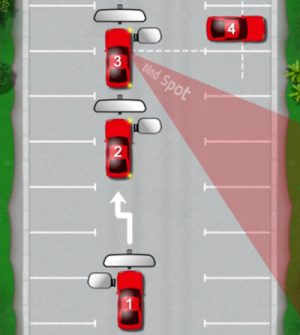
Forward park into a bay – turning to the right
This part of the tutorial covers a forward bay park to the right. The reversing part of the manoeuvre is explained later.
- Create as wide a turning circle as possible – this makes it easier to enter the bay accurately. Move over to the left as far as you safely can, without driving over bay markings or getting too close to other vehicles. Before moving left, check your interior mirror and left mirror.
- Show your intentions clearly by signalling right. Before signalling, check your interior mirror followed by your right door mirror.
- Reach your first reference point, which is also your point of turn (see forward parking to the right reference point). From the bay you intend to use, when the first line appears just under your right door mirror, stop the car if you wish. Stopping here slows the manoeuvre and helps observation. Now check your interior and right mirror, followed by the right blind spot. If all clear, very slowly move off and steer quickly to full right lock.
- As you enter the bay, straighten the steering when your dashboard lines up with the horizon or a fixed object like a hedge or fence. To know where to stop, use the next reference point: when the end bay line or kerb appears just under your door mirror (see reference points). When it reaches this point, you should be safely in the bay. Select neutral and apply the handbrake.
Forward Bay Parking to the Left
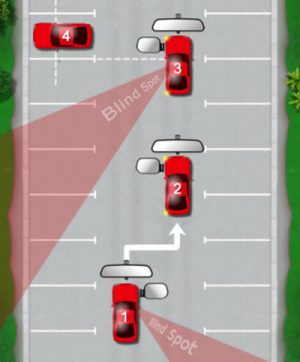
Forward park into a bay – turning to the left
This section covers a forward bay park to the left. If you have the option, turning right into a bay can sometimes be easier because it gives clearer sight of the bay lines as you enter.
Also, turning right into a bay usually keeps you on the correct side of the road, whereas turning left into a bay can involve briefly moving onto the opposite side.
- As with turning right, you need to maximise your turning angle. Move over to the opposite side of the road before turning. Before doing this, check your interior and right mirror and your right blind spot.
- Now check your interior and left mirror and signal left.
- Reach your reference point and point of turn (see forward bay to the left reference point). Stopping here slows the manoeuvre and improves observation. Because you are on the opposite side of the road, this is more hazardous, so before turning check the interior and left mirror, then the left blind spot. If all clear, move off slowly and steer quickly to full left lock.
- Enter the bay and use the end bay line or kerb as your stopping reference. When it comes just under your door mirror, you should be in a good position within the bay.
If you’d like to practise left and right bay parking in a quiet car park first, you can start here:
Manual lesson prices and Automatic lesson prices.
Reversing Out of the Bay
- Some car parks, especially tight ones, use a one-way system. If there are painted arrows showing the traffic flow, you must reverse in a direction that allows you to drive off with the flow of traffic.
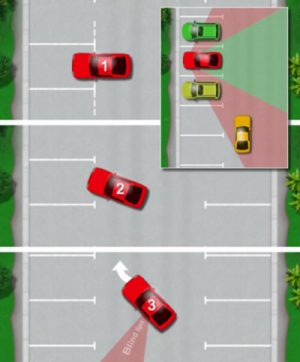
- Your view of the road you’re reversing into can be very restricted, especially with vehicles parked either side. The green shaded area in the inset image shows the limited view you often have. Start reversing very slowly, continuously look up and down the road and stop if any vehicles approach. If possible, look through the windows of parked cars to help with observation.

Reversing out of a bay
Before reversing, prepare the car by selecting reverse gear and placing your hand on the handbrake ready to release. Look up and down the road you will reverse into as far as you can see. If it looks clear, look in the direction of travel and begin reversing very slowly – think “crawling” speed. Be ready to stop quickly. If a vehicle approaches, stop and see what they do. They may drive around you or wait. If they clearly wait, you may continue, but always keep looking around and be ready to stop again. Continue reversing straight until you reach your reference point.
- As you start to turn, the front of your car will swing out. You must watch both the road you’re reversing into and the front corners of your car to avoid hitting any parked vehicles. At the point of turn, steer half a turn to the left or right (see forward bay park ‘reversing out’). Steer left to reverse left and right to reverse right. Once you’re confident the front of your car is clear of vehicles, continue to full lock.
- Continue reversing on full lock for a safe distance until you’re sure you have enough space to drive away. Stop, select first gear and, before moving off, check the blind spot on the side you will drive towards (left blind spot if you reversed to the left, right blind spot if you reversed to the right) to make sure no pedestrians, cyclists or motorcyclists are about to pass in front.
Practise forward and reverse bay parking with a DVSA-approved instructor in Hackney and East London.
View manual lesson prices →
View automatic lesson prices →
Or contact us here →
Turn parking diagrams into real confidence
Reading about parking helps, but practising in the car builds real confidence.
- Choose manual or automatic lessons
- Check lesson prices and plan your first session
- Contact us to book your lessons
Manual lesson prices →
Automatic lesson prices →
Contact us →
DVSA-Approved Instructor • Manual & Automatic • ★★★★★ Local Reviews
Start here: AMDI Driving School