
Learning How to Deal With Pedestrian Crossings
During the driving test, the routes will almost always include different types of pedestrian crossings. Examiners have strict standards around how you approach and respond to pedestrians, and many tests are failed for mistakes at crossings.
Knowing the correct rules from a driver’s point of view is essential if you want to pass the UK practical driving test and stay safe afterwards.
Learn how to handle crossings, pedestrians and zig zag lines on real East London roads.
View manual lesson prices →
View automatic lesson prices →
Types of Pedestrian Crossings
Listed below are the most common types of pedestrian crossing found on UK roads. Many of these are likely to appear on your driving test. Each type has its own rules and timings that you must understand as a driver.
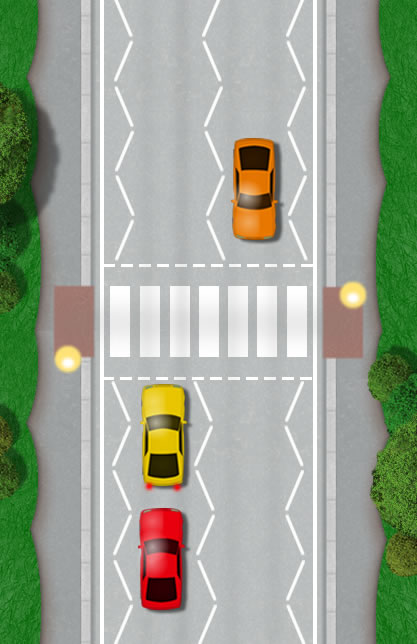
Zebra crossing
Zebra Crossing
The Zebra Crossing was first introduced to UK roads in 1949. For many years it was a very effective way to help pedestrians cross safely.
In recent years, some drivers have become less willing to slow or stop for people waiting at Zebras, which has reduced their safety. Although they are cheaper to install than modern light-controlled crossings, many are now being replaced.
As a driver, you should:
– Be ready to slow down as you approach
– Stop if a pedestrian has stepped onto the crossing
– Be cautious of people waiting at the edge
The Zebra Crossing guide explains the correct method for dealing with Zebras and the rules that apply to drivers.
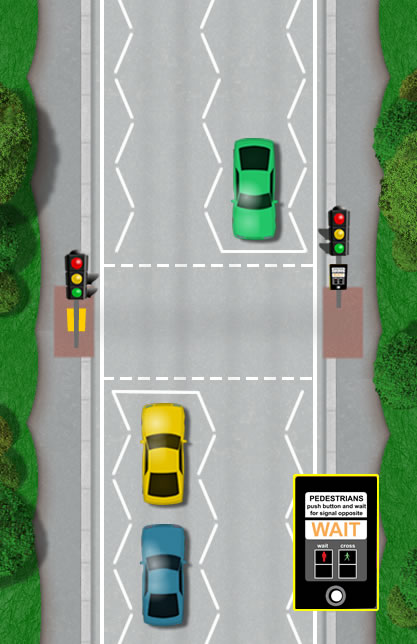
Pelican crossing
Pelican Crossing
Introduced in 1969, the Pelican Crossing was the first successful light-controlled pedestrian crossing on UK roads.
Pelicans use a special flashing amber phase:
A flashing amber light on a Pelican Crossing allows drivers to proceed only if the crossing is clear.
This helps reduce waiting times for traffic but can confuse some drivers, which increases risk for pedestrians.
As a driver you must:
– Stop on steady red
– Be prepared to move on flashing amber if the crossing is fully clear
– Always check carefully for late pedestrians
The Pelican Crossing guide explains how to approach these crossings safely and how to deal with people still walking as the lights change.
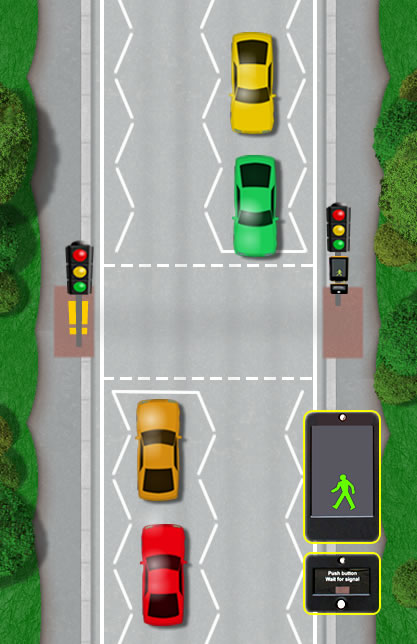
Puffin crossing
Puffin Crossing
Puffin Crossings (introduced in the 1990s) are the most advanced common type of crossing.
They still use a push-button, but have sensors that:
– Detect pedestrians waiting
– Detect people crossing the road
If no one is detected, the lights return to normal sooner, which keeps traffic moving.
Unlike Pelicans, Puffins do not use a flashing amber phase. The timing is adjusted by the sensors instead. The Puffin Crossing guide explains how they differ from Pelicans and how to approach them on test routes.
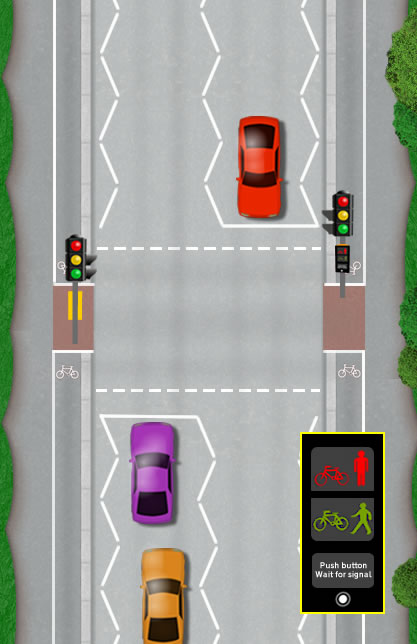
Toucan crossing
Toucan Crossing
Toucan Crossings are designed for both pedestrians and cyclists to cross at the same time, using separate entrance, crossing and exit areas.
Key features:
– Wider layout to fit both cyclists and pedestrians
– Often placed on busy routes with many people cycling and walking
– Can use either Pelican-style timing or Puffin-style sensors
The name “Toucan” comes from “two can” cross together – pedestrians and cyclists.
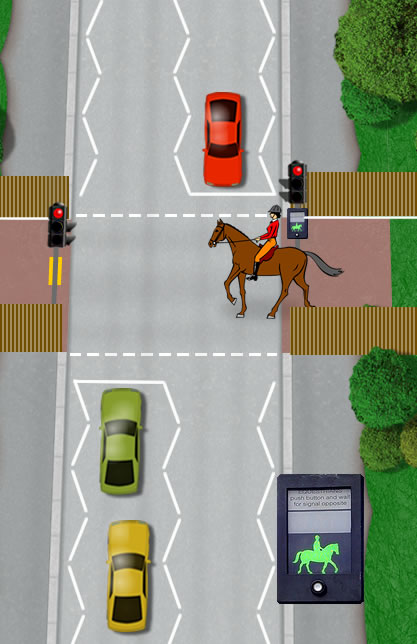
Equestrian Crossing
Equestrian Crossing
Equestrian Crossings (also known as Pegasus Crossings) are designed for:
– Pedestrians
– Dismounted horse riders
– Mounted horse riders
There are two control panels:
– A standard lower button for pedestrians
– A higher button (around 2 metres) for mounted riders
The crossings are usually wider to allow for horses and people to cross safely side by side.
Zig Zag Road Lines
There are strict rules around the white zig zag lines that lead up to pedestrian crossings.
You must not:
– Park or stop on zig zags (except when forced to by traffic)
– Overtake on zig zags
Police and enforcement cameras can issue fixed penalty notices. Offences can lead to:
– A fine
– Three penalty points
Many modern crossings now have cameras specifically to catch drivers ignoring these rules.
Practise crossings, zig zag rules and real test routes with AMDI Driving School in Hackney and East London.Manual driving lesson prices →
Automatic driving lesson prices →
Or contact us to book your lessons →
DVSA-Approved Instructor • Manual & Automatic • ★★★★★ Local Reviews
Start here: AMDI Driving School