
Learning How to Deal With Traffic Light Junctions
Whilst learning to drive, you will come across many traffic lights. The UK traffic light sequence is an essential part of learning to drive and for passing the theory test.
Understanding the basic light sequence is usually simple. The real challenge is dealing with other road users and pedestrians at busy, light-controlled junctions.
It is important to obey traffic light signals, but equally important to stay aware of what is around you. Cyclists and pedestrians in particular can be unpredictable around traffic lights.
This guide explains:
– UK traffic light sequences
– Filter arrows and how they work
– Common rules, mistakes and legal points
Learn with a calm, DVSA-approved driving instructor in Hackney & East London.
View manual lesson prices →
View automatic lesson prices →
UK Traffic Lights Sequence Explained
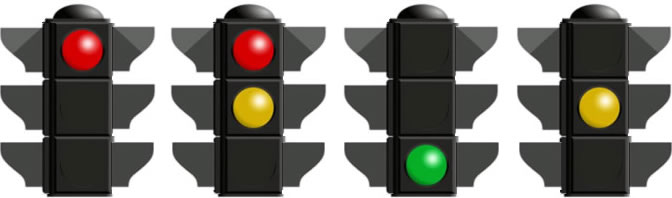
- Red traffic light
You must stop just behind the white stop line at the traffic lights. - Red and amber traffic lights
This also means stop, but you should prepare to go. You must not pass through until the green light is illuminated. - Green traffic light
You may proceed if the way is clear. Always check mirrors and check the junction is safe. - Amber traffic light
You must prepare to stop just before the stop line. You may only continue through an amber if you have already crossed the line, or are so close that stopping could cause an accident.
AMDI can help you link the theory to real road situations at local junctions.
Contact us to book lessons →
Traffic Filter Lights
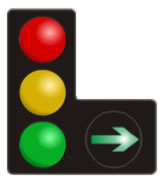
Traffic filter lights
A green traffic filter light allows traffic to move in the direction of the arrow.
When the green filter arrow is lit:
– You have priority in that direction
– Oncoming traffic will usually be held on red
Even with priority, always check for:
– Pedestrians
– Cyclists
– Vehicles that may be jumping the lights
It is common for learner drivers to stare at the main red light and miss a green filter arrow. On a driving test, if you fail to notice a green filter for a long time, this can lead to a fault or even a serious mistake.
A filter light may come on before or after the main green phase, so keep an eye on both.
Box Junctions
Traffic filter lights can appear at box junctions too. If a yellow box is painted on the road, you must only enter it when your exit is clear, even with a green filter arrow.
- See Box Junction for further information.
Traffic Filter Light Rules
Below are the rules for the red car turning right at a crossroads where a filter traffic light is present.
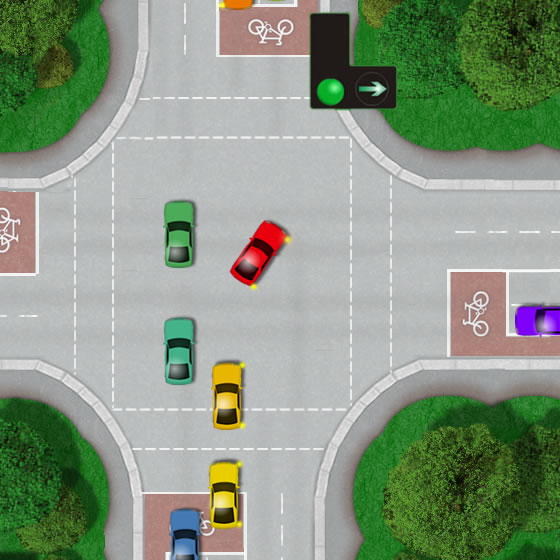
Green filter light illuminated
Green Filter Light Illuminated
If you are turning right and the green filter arrow is lit:
– Oncoming traffic will be on red
– You have priority to make the turn
You must still:
– Check for pedestrians and cyclists
– Make sure the junction is clear before moving
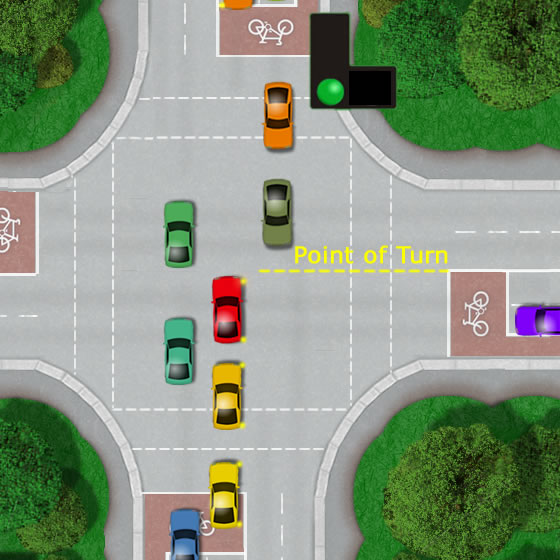
Green filter light not illuminated
Green Filter Light Not Illuminated
If you are turning right and the filter arrow is not lit (or goes off), but the main full green light is on:
– You can still proceed, but
– You must now give way to oncoming traffic
Move forward to the “point of turn”, wait, and only turn when it is safe.
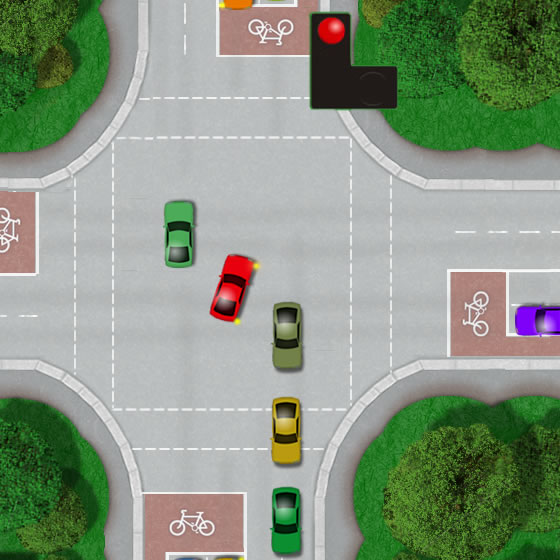
Traffic light turned red
Traffic Light Turned Red
If you are already in the junction, waiting to turn right, and the light turns red:
– Wait for any remaining oncoming vehicles to stop
– Then complete your turn and leave the junction
Do not stay sitting in the middle of the junction. This blocks traffic and is unsafe.
Traffic Light Stop Line
All traffic lights have a stop line. Some have advanced stop lines and a coloured cycle bay in front.
When the lights are red:
– All traffic must stop at the first stop line
– You should not wait inside the cycle area when stationary
Slow Moving Traffic
In slow-moving queues, it’s tempting to move forward and block the junction “just to get through”.
Technically, blocking a junction is usually not illegal unless markings such as a yellow box apply. But it does:
– Impede traffic flow
– Create frustration and risk
Best practice:
– Only enter a junction if you are sure you can clear it, even when your light is green.
Driving Test Traffic Lights
On a test, you should use the same routine as at junctions:
– MSPSL – Mirror, Signal, Position, Speed, Look
– Plus good anticipation and planning
For example:
– If lights ahead have been green for a long time, be ready for them to change
– If you see pedestrians waiting at a crossing, expect the lights to change
Pedestrian Crossing Traffic Lights Sequence
Most light-controlled pedestrian crossings use the same sequence as normal traffic lights.
Pelican crossings are different because they have a flashing amber phase:
– Flashing amber means you may proceed if the crossing is clear
Newer Puffin crossings are gradually replacing Pelican crossings. See pedestrian crossing for more detail.
Traffic Light Cameras
Running a red light is dangerous and many junctions have cameras.
If you:
– Go through a red
– Or stop well over the stop line
…you can trigger the camera. This can mean:
– A £200 fine
– 3 penalty points
– An instant driving test fail for a learner
Traffic Light Failure
If you arrive at a junction where the traffic lights have failed:
– Treat it as an unmarked junction or crossroads
– No one has priority
– Proceed very slowly and only go when you are sure it is safe
Practise real-life junctions, filter lights and cameras with AMDI Driving School in Hackney.Manual driving lesson prices →
Automatic driving lesson prices →
Or contact us to book your lessons →
DVSA-Approved Instructor • Manual & Automatic • ★★★★★ Local Reviews
Start here: AMDI Driving School